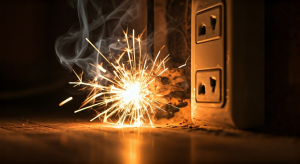
Electrical safety in Santa Monica is more important in summer than any other time of year. When temperatures rise and air conditioners run for hours every day, your home’s electrical system is working harder than it does in any other season. Older panels and circuits that have been managing just fine through mild weather can fail when the load spikes. Warning signs that seemed minor in spring — a breaker that tripped once, an outlet that felt a little warm — become real problems in July. This guide covers the electrical safety checks every Santa Monica homeowner should do before and during summer, and the warning signs that mean you need to call a licensed electrician right away.
Why Summer Is Hard on Your Home’s Electrical System
Think about what your home runs in summer compared to winter. Central air conditioning alone draws 15 to 30 amps of continuous power, depending on the size of the unit and how old it is. Add a refrigerator, a dishwasher, a washer and dryer, computers, TVs, phone chargers, and possibly an EV charger in the garage, and you are putting a serious load on your panel.
From our service calls in Santa Monica during summer months, the pattern is very consistent. Calls go up sharply in June and peak in July and August. The most common findings: breakers that have been tripping repeatedly and are now failing, panels showing heat stress from running at high load for weeks, and wiring connections that have loosened from the repeated heating and cooling of seasonal demand cycles.
This is not bad luck. It is what happens when electrical infrastructure built for 1970s household loads meets a 2020s household. The good news is that most of these problems are preventable if you catch them before summer hits hard.
Safety Check 1 — Look at Your Panel
Open your electrical panel door and take five minutes to look at it. You are not doing any electrical work — just looking. Here is what to watch for:
- Any darkening, scorching, or discoloration around the breakers or the metal bar they connect to (called the bus bar)
- Breakers that are not sitting flush in the on position — older breakers sometimes lose the firm click that tells you they are fully engaged
- Any smell of burning plastic or electrical burning coming from the panel area
- Circuit labels that are missing, wrong, or unreadable — you need to know which breaker controls which area, especially in an emergency
If you see any discoloration, smell anything unusual, or find breakers that feel loose or do not click firmly into place, call a licensed electrician before you start running the AC at full blast all day. A panel assessment costs less than $200 and can tell you exactly what you are dealing with.
Safety Check 2 — Test Your GFCI Outlets
GFCI outlets are the ones with the TEST and RESET buttons, found in kitchens, bathrooms, garages, and outdoor areas. They protect you from electric shock near water by cutting power the moment they detect a ground fault.
The problem is that GFCI outlets can fail silently. A failed GFCI still passes power to devices — so your appliances work fine — but it will not trip in a ground fault, which means it is not protecting you anymore.
Testing is simple. Press the TEST button. The outlet should go completely dead — no power at all. Press RESET. Power comes back. If the outlet does not go dead when you press TEST, the GFCI has failed and needs to be replaced. GFCI replacement is a quick, low-cost job for a licensed electrician.
Go through every GFCI outlet in your Santa Monica home. Test each one. If any fail, make a note and get them replaced before summer outdoor entertaining season and before you start running heavy appliances near water.
Safety Check 3 — Test Your Smoke Detectors
Electrical fires often start inside walls and panels before any smoke reaches your living areas. Working smoke detectors are your main warning system when an electrical problem escalates before you notice it.
Press and hold the test button on each detector. It should beep loudly. If it does not beep, replace the battery. If it still does not beep with a fresh battery, replace the whole detector. California law requires working smoke detectors in every sleeping area and just outside every sleeping area. If yours are old (detectors are recommended to be replaced every 10 years), summer is a good time to replace them before peak risk season hits.
“The calls we get in July are very predictable. The same panel that seemed fine all spring starts tripping breakers the moment the AC runs all day. That panel was not fine — it was barely keeping up, and summer pushed it over. Fix borderline before summer, not during.”
— Hussein, Zoom Electricians
Safety Check 4 — Look at Your Extension Cords and Power Strips
Summer brings extra electrical loads — portable fans, window AC units for rooms without central AC, outdoor entertaining setups. All of these tend to involve extension cords and power strips. Here is what to check:
- No extension cords under rugs or carpets. Rugs trap heat. An extension cord under a rug can get hot enough to start a fire and you will not see it happening. Move the rug or run the cord along a baseboard instead.
- No extension cord used permanently. Extension cords are for temporary use. If you have one that has been running a lamp or appliance in the same spot for months, have an outlet installed at that location instead.
- No power strips plugged into power strips. Plugging one power strip into another — called daisy-chaining — overloads the first strip’s connection to the wall. This is a fire hazard. Each power strip should plug directly into a wall outlet.
- Outdoor cords rated for outdoor use. Indoor extension cords used outside are a safety risk in wet conditions. Look for “outdoor rated” or “weatherproof” on the label before using any cord outside.
Safety Check 5 — Check Your Outdoor Outlets
If you have outdoor outlets on your patio, deck, or exterior walls, make sure they are GFCI protected. Outdoor outlets that lack GFCI protection can cause fatal electrocution if water gets into the connection — rain, a sprinkler, wet hands. If your outdoor outlets do not have TEST and RESET buttons and are not on a circuit protected by a GFCI outlet indoors, have them upgraded.
Outlet covers for outdoor use should be the “in-use” bubble type — these protect the plug connection even when a device is plugged in and the cord is hanging down. Standard flat covers only protect an empty outlet. In summer, when you are running string lights, a speaker, or a fan outdoors, you need the in-use style cover.
AC Safety: Window Units and Portable ACs
Window air conditioning units are common in older Santa Monica homes and rentals that do not have central AC. They draw a lot of power — a 10,000 BTU unit typically pulls 10 to 12 amps. Here is how to use them safely:
- Plug window AC units directly into a wall outlet — never into an extension cord or power strip
- Check the circuit capacity before running a window AC alongside other appliances on the same circuit
- If you need a dedicated circuit for a window AC, that is a job for a licensed electrician with a permit from City Building Department
According to the National Fire Protection Association, electrical failures and malfunctions cause roughly 51,000 home fires per year in the United States. Avoiding simple mistakes with extension cords and overloaded circuits is one of the most effective ways to reduce that risk in your own home.
When to Call an Electrician Right Away
Some things require immediate professional attention. Do not wait, do not reset the breaker again, do not assume it will go away on its own:
- A burning smell from your panel or any outlet
- Any outlet or switch that feels warm or hot to the touch
- Sparks or visible scorch marks at any outlet or switch
- A breaker that trips immediately when reset, over and over
- Any sign of water damage near electrical outlets, panels, or junction boxes
For all electrical safety concerns in Santa Monica — panel assessments, GFCI upgrades, outlet additions, or anything that showed up during your pre-summer checks — contact Zoom Electricians. We serve all of Santa Monica and Los Angeles County with licensed, permitted work. If your summer preparations also include plumbing upgrades — outdoor irrigation, hose bibs, or bathroom work — our partner network includes a plumbing in Santa Ana for customers across our Southern California service area.
The Difference Between Homeowner Tasks and Electrician Tasks
Here is a simple way to know what you can do yourself and what needs a licensed electrician:
- You can do: Reset tripped breakers, press the TEST button on GFCI outlets, press the TEST button on smoke detectors, replace smoke detector batteries, replace light bulbs
- Call a licensed electrician: Everything else. Opening the panel, replacing breakers, replacing outlets or switches, adding new circuits, any work that involves making or changing wire connections inside an outlet box, switch box, junction box, or the panel itself
The busiest weeks for electricians in Santa Monica are July and August, when people who delayed addressing borderline issues are now dealing with failures. Booking now, before peak season, means you get the work done on your schedule and at the regular rate — not as an emergency call with a premium.
Electrical Safety for Santa Monica Rental Properties and Landlords
If you own a rental property in Santa Monica, electrical safety is not just a personal safety matter — it is a legal obligation. California Civil Code requires rental properties to be habitable, and habitable includes functional and safe electrical systems. A landlord who is aware of a known electrical hazard — a flagged panel brand, documented aluminum wiring in poor condition, or outlets that are known to fail — and does not address it faces liability exposure if a tenant is injured or a fire occurs.
From a practical standpoint, the most important electrical safety step for Santa Monica rental property owners is a professional electrical assessment of every unit, performed by a licensed electrician, at a reasonable interval. Annual inspection before a new tenancy begins is a good practice. Addressing issues found during inspection — even if they are not yet causing visible symptoms — is far less expensive than addressing the aftermath of an electrical incident.
Zoom Electricians works with Santa Monica landlords and property managers on scheduled electrical assessments and maintenance programs for rental properties throughout Los Angeles County. We document all work with proper permits and inspections, which protects landlords from liability claims based on unpermitted work.
Summer Electrical Fires — How They Start and How to Prevent Them
Electrical fires in summer have a consistent pattern. The trigger is usually not a dramatic event — it is the quiet accumulation of heat in a connection or wire that has been degraded for years and finally reaches the ignition point under summer’s sustained high load.
Here is what happens: an old, loose connection — an outlet backstab connection that loosened over years of thermal cycling, an aluminum wire oxidized at a switch terminal, a wire nut that has dried out and is no longer maintaining firm contact — creates resistance in the circuit. Resistance generates heat. When the load is moderate, the connection gets warm. When summer comes and loads are high and sustained — the AC, the refrigerator, the computers, all running for hours — that connection gets hot. Hot enough to ignite nearby insulation, or adjacent wood framing, or the drywall around it.
The home does not show any obvious signs until the fire is well established inside the wall. By the time the smoke detector triggers, a significant fire has already started.
This is why the pre-summer electrical safety check described in this guide is so important. Finding and fixing loose connections, replacing failing GFCI outlets, and having a professional assess the panel is not routine maintenance — it is fire prevention. Take it seriously before summer’s peak load season arrives.
Why Santa Monica Homeowners Choose Zoom Electricians
When Santa Monica homeowners need electrical work done, they want a few things above everything else: someone licensed and insured, someone who pulls the permits, someone who handles the rebate paperwork so they do not have to, and someone who shows up when they say they will and does the work right the first time. Those are the things we focus on at every job in Santa Monica and across Los Angeles County.
We serve all of Santa Monica and the surrounding Los Angeles County area with licensed C-10 electrical contractors who know the local housing stock, the local permit process, and the specific electrical conditions that come up again and again in homes built here. We are not a national call center that farms jobs out to whoever is available — we are a local team that works in these neighborhoods every day.
Every project we do comes with:
- A written estimate before any work starts — itemized, with the permit fee included, and specific about what panel brand, breaker types, and scope of work we are quoting
- Licensed work with proper permits — we pull permits for every project that requires one. No exceptions, no shortcuts. Your work is inspected and documented.
- Rebate assistance included — we assess your project for every applicable federal IRA and LADWP rebate program, handle all the paperwork, and make sure you get every dollar you qualify for
- Clear scheduling and communication — you know when we are coming, what we are doing, and what to expect on installation day before the day arrives
The easiest way to get started is to call and describe what you are dealing with. Whether it is a panel that keeps tripping breakers, a new EV that needs a home charger, a wiring question about an older home, or an insurance letter requiring an electrical upgrade — we have dealt with it many times in Santa Monica and we can tell you quickly whether it is something that needs immediate attention, something that can be scheduled, or something you can monitor for now.
Contact Zoom Electricians to schedule your Santa Monica electrical assessment or get a written estimate for any of the services covered in this guide. For Los Angeles County projects that also involve residential electrical services across multiple trades — including plumbing for kitchen and bathroom renovations, garage conversions, or ADU construction — ask about our partner network when you call.
Frequently Asked Questions About Electrical Work in Santa Monica
Before scheduling any electrical project, homeowners in Santa Monica typically have a few common questions. Here are direct answers to the ones we hear most often:
How long does the average panel upgrade take in Santa Monica? A standard 100-amp to 200-amp panel upgrade takes one installation day — typically four to eight hours for the electrical work — plus the time for the permit approval and the post-installation inspection. From first call to completed inspection, most projects take one to two weeks total.
Will my insurance go down after a panel upgrade? Some insurance carriers offer lower premiums for homes with updated electrical systems. More commonly, the benefit is the elimination of a surcharge or the restoration of coverage that was being canceled or non-renewed because of the old panel. Contact your carrier directly after your upgrade is complete and the inspection is signed off to ask about any premium adjustment.
Can I stay in my home during the work? Yes, for panel upgrades and most electrical projects. There will be a period during installation day — typically four to eight hours — when the power is off to the whole house. For rewiring projects, power is off in the areas being worked on but usually maintained in other areas. The electrician coordinates with you on the schedule to minimize disruption to your daily routine.
What is the difference between a panel upgrade and a service upgrade? A panel upgrade replaces the main panel box and the breakers inside it. A service upgrade also replaces the service entrance — the wiring from the utility meter to the panel. Some properties need both; others only need the panel. The assessment visit determines which scope your property needs.